Helping Kast build a multi-tenant platform on Orchard Core

Kast is an Australian company and one of their primary goals is to implement the Kast platform with the Kast Group Finder component. We worked together with Seth Cleaver (Co-founder and Director of Kast) on this tool to be able to create an intuitive self-service process that enables people within a church to easily find a suitable group to attend, simplify the administrative processes required for getting people into groups, and provide information to the group co-ordinators that might assist in planning and measuring effectiveness.

Background information

Every tenant of Seth's platform has a complex architecture that consists of two huge components: Event Management and Group Finder. Besides multiple church services, the Kast platform has a lot of events, including youth groups for a range of different ages, interest groups such as dances and art, men's and women's events, and so on. Some of these are single events and others are recurring. The Event Management component is responsible to provide the community and the members to easily discover these events using an attractive and easy to understand platform.

They have two websites, all running on Orchard Core:

Since March 2019 we've been helping Seth to build the Kast platform. Before starting to code together, we started with a training to give an overview of what can be achieved with Orchard Core, how can you do the content modeling, build your own custom theme from scratch and use Vue.js in Orchard Core to create multiple apps.

But what does Seth say about this?

The team at Lombiq have been an integral part of the delivery of the first release of our SaaS product in 2019. Lombiq's unique combination of expertise, talent and experience mean that they not only understand the requirements of the project they are undertaking but how it contributes to the wider vision for your product. The value of this can not be overstated. Having personally been in the web development space for over 16 years, I have found that Lombiq are one of those rare finds that consistently deliver more than expected in all that they do.

Now let's have a closer look at the Group Finder! But before doing that we have to get a deeper knowledge about how groups are made up.

Overview of what we've developed

First of all, every group has gatherings at different times. For example, a group could have gatherings every Saturday or every second Saturday at 4:30 p.m. - 5:30 p.m. To store the frequency of the recurring events that can be added to the user's calendar we decided to use RRULE strings. By using that we can programmatically define recurring and scheduled events. But of course, the users don't want to enter this kind of strings on the admin side of the site when creating happenings for the groups. We needed to implement a UI, where they can easily set up the start date and time with the end date and time and of course set the frequency. To solve this issue we implemented a form something similar that you can meet with on this page. This event date editor is created by using Vue.js.

Many churches already maintain group information and more in a church management system (ChMS), therefore our next task was to do the integration between Seth and his company and Elvanto. Calling Elvanto APIs and parse the JSON response could be not so tricky, but constructing the Group content types based on the input data involved more work.

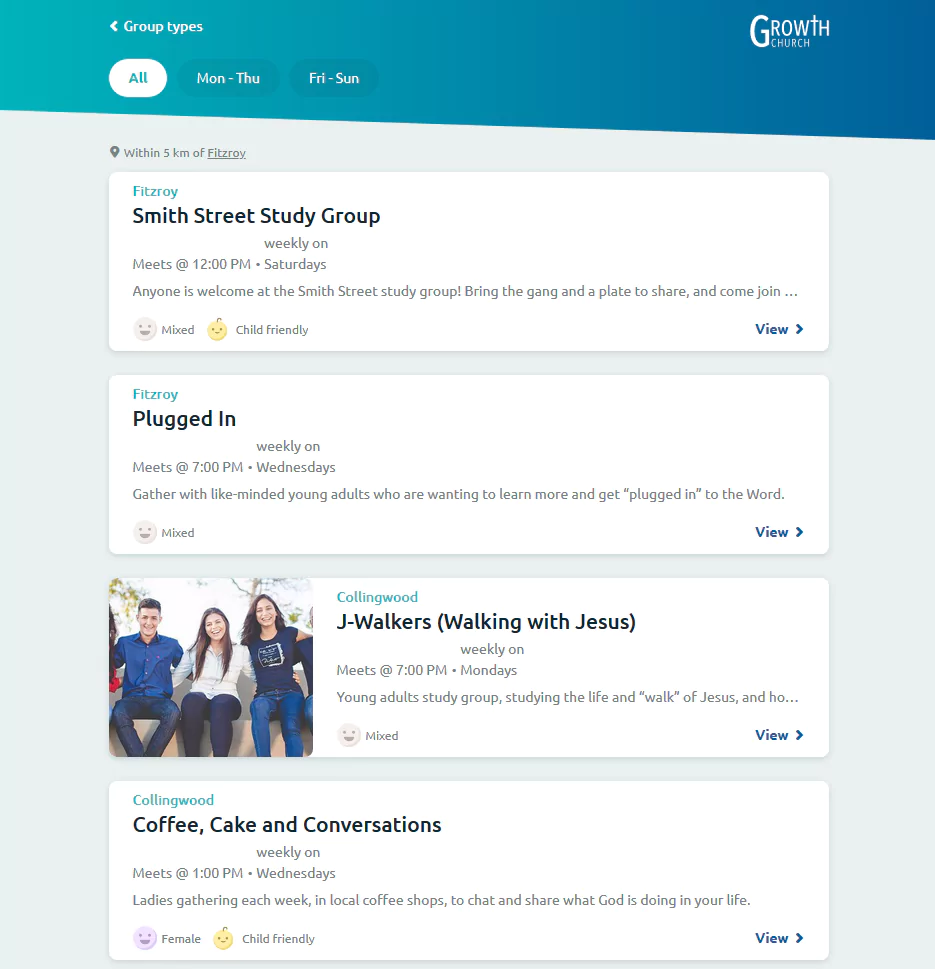
The Group Finder app itself is a Vue.js application responsible for returning groups based on various search conditions. First, users have to provide a few details about themselves, then choose the relevant group types to show the right groups. For this, we needed to provide different pages with different kinds of forms. The Vue Router (which is the official router for Vue.js) is responsible for the navigation between the pages and to build this Single Page Application for easy usage. We used our open-source Vue.js module for Orchard Core to add the Vue.js component templates to Group Finder. If you are curious about how to use Vue.js within Orchard Core, you could see some great examples in our Orchard Core Training Demo module.

There are many times when building an application for the web that you may want to consume and display data from an API. There are several ways to do so, but a very popular approach is to use axios, a promise-based HTTP client.

When users get the list of the groups they can choose between them to find the relevant groups. When users would like to connect to a group, they need to send an expression of interest first with a personalized message. This means that the user, the group coordinators, and the group leaders will get an e-mail notification about the new person who would like to join the group.

Conclusion

The platform for Seth and his company involves lots of settings using the dashboard. By using Orchard Core, we could implement an interface for users with higher permissions to easily access the settings they need (and not more) without building the whole backend of the platform from the ground. Thanks to our new custom workflow tasks that users could easily set up, sending emails to the preferred addresses are solved in a very extensible way. And because Orchard Core itself also using Vue.js in some of the built-in modules, we didn't have to go far if we needed to find great examples to solve a given problem.

Is your company also ready to make the Orchard leap? Let's have a call!

Other recent posts

Clear Specs Go a Long Way: Inside Our Three-Year Orchard Core Collaboration with Fieldman

What happens when your application needs both stability improvements and new features at the same time?

That was the situation when Lombiq joined the Fieldman project. Their Orchard Core-based web application already had established business logic, but it required bug fixes, upgrades, and further development.

Fieldman is an American software company that helps local governments and utility vendors manage all types of assets, jobs, and field projects.

Your analytics isn’t broken. It’s incomplete.

Web analytics is the foundation of modern marketing decisions. But today, a growing portion of user behavior simply doesn’t show up in your reports.

Ad blockers, browser extensions, and privacy tools can strip tracking parameters or block analytics scripts entirely. The result is incomplete campaign data, misleading attribution, and decisions based on partial visibility.

For marketing and product teams, this is not just a technical inconvenience. It is a business risk. Campaign performance becomes harder to evaluate, budgets are harder to justify, and growth decisions rely on guesswork instead of evidence.

Bringing Orchard Core into the classroom at Óbuda University

Since 2013, we’ve been working with Óbuda University on a hands-on way to teach web development. What began as a course built around Orchard CMS later evolved into an Orchard Core-based subject, giving students a chance to learn by building something that could actually work in the real world, not just completing classroom exercises.We asked our colleague Gábor Domonkos, who has led the collaboration for years, to walk us through how the course started, how it works today, and what students usually take away from it.– How did this collaboration start?At first, the university had a Hungarian, non-developer course focused on Orchard CMS and DotNest, Lombiq’s hosted Orchard platform. Students built sites through the admin UI, which was a good introduction to content management. But once Orchard Core arrived, we saw a chance to create something more ambitious: a developer-focused subject where students could also write code and go beyond the basics.– What changed with Orchard Core?Orchard Core made the course much more flexible. Students can now learn not just how to use a CMS, but how to extend it, customize it, and build on top of it. That meant more room for customization and coding. It also gives them a much more realistic picture of what it means to develop with a modern CMS on ASP.NET Core.– How is the course structured?The semester is built around a few milestones. Early on, students choose their project topic and define the basic idea. Midway through the semester, they should already have a working site with real content. By the end, the project should be close to final, both in structure and content.The later stages are mostly about making sure students stay on track. If they need help, they can share a short update so we can spot problems early and steer them in the right direction. Some students also choose to demo their project before the official deadline.– What do students usually build? Any favorites?That depends on which version of the course they take. In the non-developer version, students often build sites with forms, search, taxonomies, and content workflows. In the developer-focused version, they go further and build custom modules, themes, and more advanced functionality.One project that stands out was a volunteer platform. Organizations could publish volunteer opportunities, and users could browse, apply, and track their enrollments. It was a nice example of how Orchard Core can support a real, practical use case without adding unnecessary complexity.– Has this led to anything beyond the course?Yes, some students later became our colleagues at Lombiq. By the time they finish the course, they already know the basics of Orchard Core and have built something real with it. More importantly, they have seen what it’s like to work with a real open-source ecosystem, not just with a classroom demo.– Where should someone start if they want to learn Orchard Core today?If someone wants to learn Orchard Core today, Lombiq has a few good starting points. Dojo Course 3 is a full video course on YouTube that walks through Orchard Core for both users and developers. We also maintain the Lombiq Training Demo for Orchard Core on GitHub, which is a functional module with heavily commented code to help developers understand how Orchard Core works in practice. And beyond that, Orchard Dojo regularly publishes tutorials, tips, and other learning resources for the Orchard community. For us, that is the best proof that the collaboration works. Students gain practical experience, the university gets a more hands-on subject, and the industry gets people who are better prepared for real projects. We believe more universities could benefit from this kind of collaboration, whether with Orchard Core or other open-source technologies. And if you are exploring something similar, we are always happy to share what has worked for us so far.

Event management backend for one of the largest retailers

Avastec, a UK company, approached us to continue the development of their existing Orchard Core-based headless backend utilized by the event management site of one of the world's largest retailers. It was already in use with a publicly accessible Node.js-based frontend. The end client urgently wanted some new features, with follow-up tasks to optimize the system's performance, and keep the app up-to-date while maintaining the integrity of the user interface. Our initial task involved the transformation of data migrations from the simpler recipe-based paradigm to a more structured code-based approach. This transition aimed to enhance the traceability of modifications the development team applied. Simultaneously, a suite of UI tests was integrated into the workflow to uphold continuous code quality assurance. Leveraging the flexibility of Orchard Core's migration API, we executed this pivotal migration process without it negatively affecting users. Since then, we've delivered a lot to meet various user requirements, including event ticketing, integrating with a GDPR compliance API, and launching the site for another brand of the end client. One particularly interesting task was the implementation of QR code-based entry management, which we also supplemented with UI tests using the Lombiq UI Testing Toolbox. We've also implemented a feature to let the app use a fake video feed during tests, what we also demoed during the weekly Orchard Core podcast. From our other open-source projects, we also utilized Lombiq Helpful Extensions, as well as Lombiq Hosting - Azure Application Insights, since the app is hosted in Azure. This is what Steve Taylor, CTO and Founder of Avastec says about our joint work: Working with this team has been a genuinely positive experience from day one. They quickly understood the complexities of our existing Orchard Core setup and delivered improvements without disrupting a live, high-traffic platform. Their ability to balance rapid feature delivery with long-term maintainability and performance has been particularly valuable. The introduction of structured migrations, robust UI testing, and innovative solutions like QR-based entry management significantly elevated the quality of the system. They’ve consistently demonstrated technical expertise, reliability, and a proactive mindset, making them a trusted partner in the ongoing evolution of our platform. Thanks to Orchard Core, UI testing, and innovative feature implementations, we effectively addressed Avastec’s challenges and delivered a significantly improved event management backend. It continues to serve the end client, with us working on improvements to this day. Do you want to launch and event management platform on Orchard Core? We have actually built several more too, get in touch with us!