Smithsonian Folkways Recordings now upgraded to Orchard Core

If you like music – and, truthfully, who doesn't? –, we have some good news for you: you can now browse and license music on an Orchard Core-based platform! This is brought to you by the long-standing collaboration between Lombiq and the Smithsonian Institution, which has been engaged in a working relationship with us for several years now. The sites of the Smithsonian Center for Folklife and Cultural Heritage were made using Orchard 1, which we had a hand in creating all the way back in 2017. These Orchard-powered sites also include the home of the Smithsonian Folkways Recordings, which is now running on Orchard Core instead!
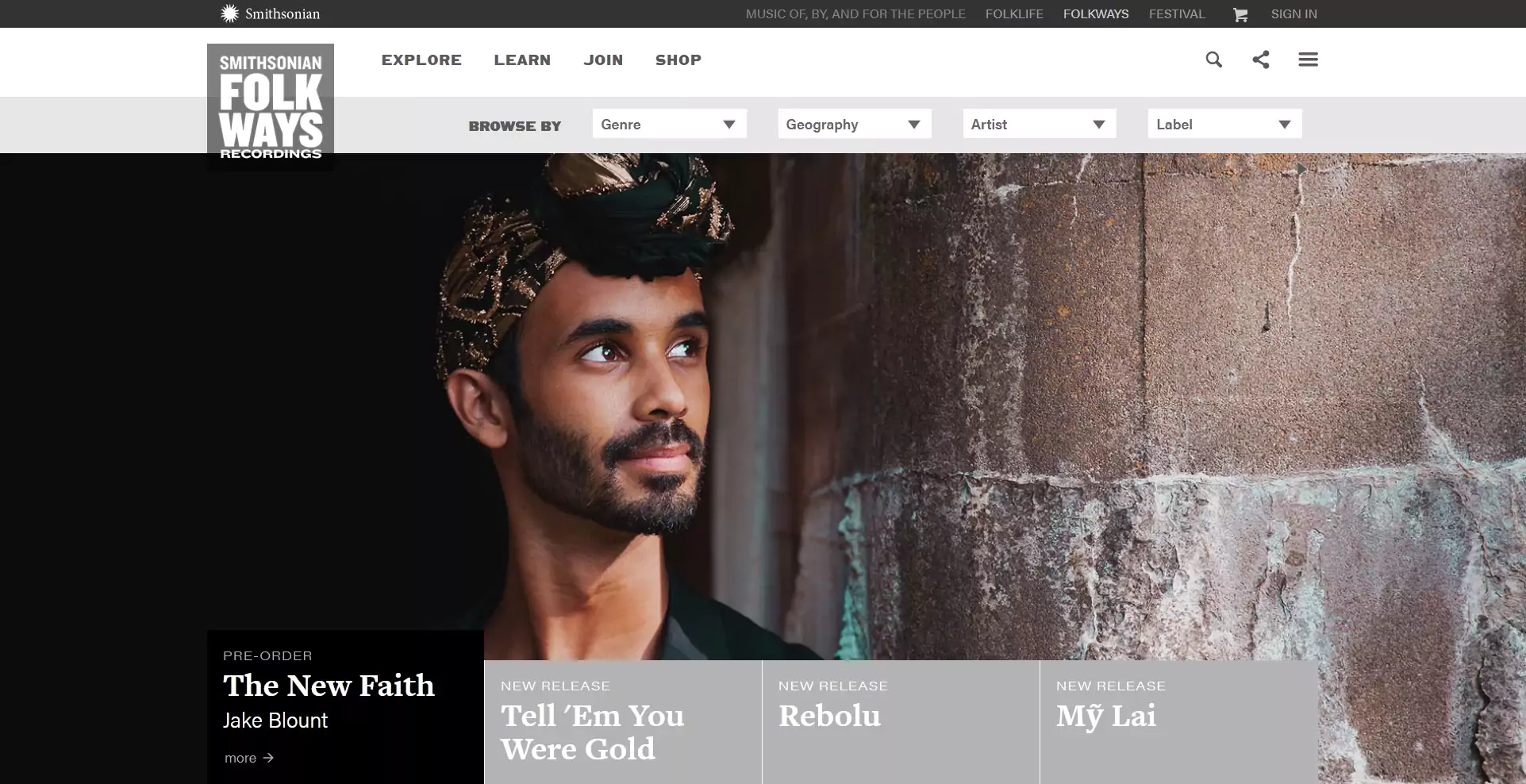
Smithsonian Folkways Recordings homepage

Folkways, with music and Orchard at its core

With Orchard Core offering an ever-growing number of benefits over its predecessor, including various performance improvements and a more user-friendly UI, the time to upgrade from Orchard 1 drew near by the end of 2021. Due to our long history with the Institution, we had the opportunity to participate in this project too.

Lombiq took a major part in the migration process that was ongoing earlier this year. This included updating the existing codebase to modern standards using the latest C# language features, re-implementing our Content Editors module to make it Orchard Core compatible, as well as adding UI testing to easily spot regressions. The application also makes use of several of our open-source projects such as Helpful Libraries, Helpful Extensions, Gulp Extensions, and NPM MSBuild Targets.

The new Folkways site launched in July and can be found on our showcase website Show Orchard as well.

This is what Toby Dodds, Technology Director at Smithsonian Folkways Recordings, had to say regarding our collaboration:

During the past year we’ve had the pleasure of working collaboratively with Lombiq to upgrade our backend CMS from Orchard’s 1.x to its more modern 2.x version Orchard Core – based on Microsoft’s Dot.Net Core. This was a complex and difficult project, but essential as well, and once again we feel lucky to have been able to work through it with Lombiq. Anyone who works around Web or IT systems knows that they are not static and always grow and expand in complexity. Collections of data grow as do the number of fields. Our collection database, which is now 20 years old is at the core of our whole enterprise and represents millions of pieces of information. Years ago, we determined that we could leverage Microsoft technologies and Orchard’s CMS to manage that data while simultaneously supporting our website. This strategy has paid off and we have been able to thrive as a business, generating revenue through sales on our website, licensing opportunities, in-kind donations, and through the distribution of our catalog to outside digital music services. All this business is data-centric and working with Orchard has given us total control of our data landscape.

A big challenge, and a breakthrough, of Orchard Core is that data is accessed in a code-based way which results in better performance but required us to complete a complex migration of our data from our 1.x database held in MS SQL Server. Thankfully Lombiq was ready to take this on, helping us build a data migration process that worked like a charm and was a bridge between the old and the new. We were also able to retain access to our data in SQL, allowing us to keep our existing integrations, and the ability to query our data directly when necessary. Because data is managed within the application layer now, we have also leaned on Lombiq to develop a set of tools to Import, Export, and Update our collection using Excel spreadsheets. Our data life has gotten easier as a result and we are now better prepared to acquire, process, and distribute recordings and collections moving forward. Orchard Core represents not only a step forward for our website but also for our collection management work as well.

Specifically on the website we have also been able to take advantage of Orchard Core’s improved speed to produce new tools for browsing the collection.  Being able to browse and filter thousands of releases in a nanosecond is cool, no matter how you slice it. Additionally, this new speed on our website is opening a door for us to introduce a streaming audio player that depends on AJAX to maintain a persistent audio listening experience while browsing the site. This only works well if pages load quickly and do they ever! Getting to streaming is a key priority for us and now we expect to make that available to the public next year.

In summary, this has been an innovative and productive period for Folkways and now that we are in Orchard Core, we are looking forward to all the benefits that will come from this hard-fought upgrade. Our success here is thanks to Lombiq who’ve had the skill, vision, and patience to work with us to overcome big challenges and get the job done.

You can also check out a demo video of the app and our experiences developing it here.

As Orchard Core grows in popularity, so does our experience with it. If you too would like to enjoy the various improvements the platform offers, don't hesitate to reach out to us here.


Other recent posts

Clear Specs Go a Long Way: Inside Our Three-Year Orchard Core Collaboration with Fieldman

What happens when your application needs both stability improvements and new features at the same time?

That was the situation when Lombiq joined the Fieldman project. Their Orchard Core-based web application already had established business logic, but it required bug fixes, upgrades, and further development.

Fieldman is an American software company that helps local governments and utility vendors manage all types of assets, jobs, and field projects.

Your analytics isn’t broken. It’s incomplete.

Web analytics is the foundation of modern marketing decisions. But today, a growing portion of user behavior simply doesn’t show up in your reports.

Ad blockers, browser extensions, and privacy tools can strip tracking parameters or block analytics scripts entirely. The result is incomplete campaign data, misleading attribution, and decisions based on partial visibility.

For marketing and product teams, this is not just a technical inconvenience. It is a business risk. Campaign performance becomes harder to evaluate, budgets are harder to justify, and growth decisions rely on guesswork instead of evidence.

Bringing Orchard Core into the classroom at Óbuda University

Since 2013, we’ve been working with Óbuda University on a hands-on way to teach web development. What began as a course built around Orchard CMS later evolved into an Orchard Core-based subject, giving students a chance to learn by building something that could actually work in the real world, not just completing classroom exercises.We asked our colleague Gábor Domonkos, who has led the collaboration for years, to walk us through how the course started, how it works today, and what students usually take away from it.– How did this collaboration start?At first, the university had a Hungarian, non-developer course focused on Orchard CMS and DotNest, Lombiq’s hosted Orchard platform. Students built sites through the admin UI, which was a good introduction to content management. But once Orchard Core arrived, we saw a chance to create something more ambitious: a developer-focused subject where students could also write code and go beyond the basics.– What changed with Orchard Core?Orchard Core made the course much more flexible. Students can now learn not just how to use a CMS, but how to extend it, customize it, and build on top of it. That meant more room for customization and coding. It also gives them a much more realistic picture of what it means to develop with a modern CMS on ASP.NET Core.– How is the course structured?The semester is built around a few milestones. Early on, students choose their project topic and define the basic idea. Midway through the semester, they should already have a working site with real content. By the end, the project should be close to final, both in structure and content.The later stages are mostly about making sure students stay on track. If they need help, they can share a short update so we can spot problems early and steer them in the right direction. Some students also choose to demo their project before the official deadline.– What do students usually build? Any favorites?That depends on which version of the course they take. In the non-developer version, students often build sites with forms, search, taxonomies, and content workflows. In the developer-focused version, they go further and build custom modules, themes, and more advanced functionality.One project that stands out was a volunteer platform. Organizations could publish volunteer opportunities, and users could browse, apply, and track their enrollments. It was a nice example of how Orchard Core can support a real, practical use case without adding unnecessary complexity.– Has this led to anything beyond the course?Yes, some students later became our colleagues at Lombiq. By the time they finish the course, they already know the basics of Orchard Core and have built something real with it. More importantly, they have seen what it’s like to work with a real open-source ecosystem, not just with a classroom demo.– Where should someone start if they want to learn Orchard Core today?If someone wants to learn Orchard Core today, Lombiq has a few good starting points. Dojo Course 3 is a full video course on YouTube that walks through Orchard Core for both users and developers. We also maintain the Lombiq Training Demo for Orchard Core on GitHub, which is a functional module with heavily commented code to help developers understand how Orchard Core works in practice. And beyond that, Orchard Dojo regularly publishes tutorials, tips, and other learning resources for the Orchard community. For us, that is the best proof that the collaboration works. Students gain practical experience, the university gets a more hands-on subject, and the industry gets people who are better prepared for real projects. We believe more universities could benefit from this kind of collaboration, whether with Orchard Core or other open-source technologies. And if you are exploring something similar, we are always happy to share what has worked for us so far.

Event management backend for one of the largest retailers

Avastec, a UK company, approached us to continue the development of their existing Orchard Core-based headless backend utilized by the event management site of one of the world's largest retailers. It was already in use with a publicly accessible Node.js-based frontend. The end client urgently wanted some new features, with follow-up tasks to optimize the system's performance, and keep the app up-to-date while maintaining the integrity of the user interface. Our initial task involved the transformation of data migrations from the simpler recipe-based paradigm to a more structured code-based approach. This transition aimed to enhance the traceability of modifications the development team applied. Simultaneously, a suite of UI tests was integrated into the workflow to uphold continuous code quality assurance. Leveraging the flexibility of Orchard Core's migration API, we executed this pivotal migration process without it negatively affecting users. Since then, we've delivered a lot to meet various user requirements, including event ticketing, integrating with a GDPR compliance API, and launching the site for another brand of the end client. One particularly interesting task was the implementation of QR code-based entry management, which we also supplemented with UI tests using the Lombiq UI Testing Toolbox. We've also implemented a feature to let the app use a fake video feed during tests, what we also demoed during the weekly Orchard Core podcast. From our other open-source projects, we also utilized Lombiq Helpful Extensions, as well as Lombiq Hosting - Azure Application Insights, since the app is hosted in Azure. This is what Steve Taylor, CTO and Founder of Avastec says about our joint work: Working with this team has been a genuinely positive experience from day one. They quickly understood the complexities of our existing Orchard Core setup and delivered improvements without disrupting a live, high-traffic platform. Their ability to balance rapid feature delivery with long-term maintainability and performance has been particularly valuable. The introduction of structured migrations, robust UI testing, and innovative solutions like QR-based entry management significantly elevated the quality of the system. They’ve consistently demonstrated technical expertise, reliability, and a proactive mindset, making them a trusted partner in the ongoing evolution of our platform. Thanks to Orchard Core, UI testing, and innovative feature implementations, we effectively addressed Avastec’s challenges and delivered a significantly improved event management backend. It continues to serve the end client, with us working on improvements to this day. Do you want to launch and event management platform on Orchard Core? We have actually built several more too, get in touch with us!